> ## Documentation Index
> Fetch the complete documentation index at: https://docs.powersync.com/llms.txt
> Use this file to discover all available pages before exploring further.
# Securing Your Deployment
> Network architecture and security guidance for self-hosted PowerSync deployments.
This section is a work in progress. Please reach out on [our Discord](https://discord.gg/powersync) if you have specific questions.
Below is an architecture diagram of a successful deployment:
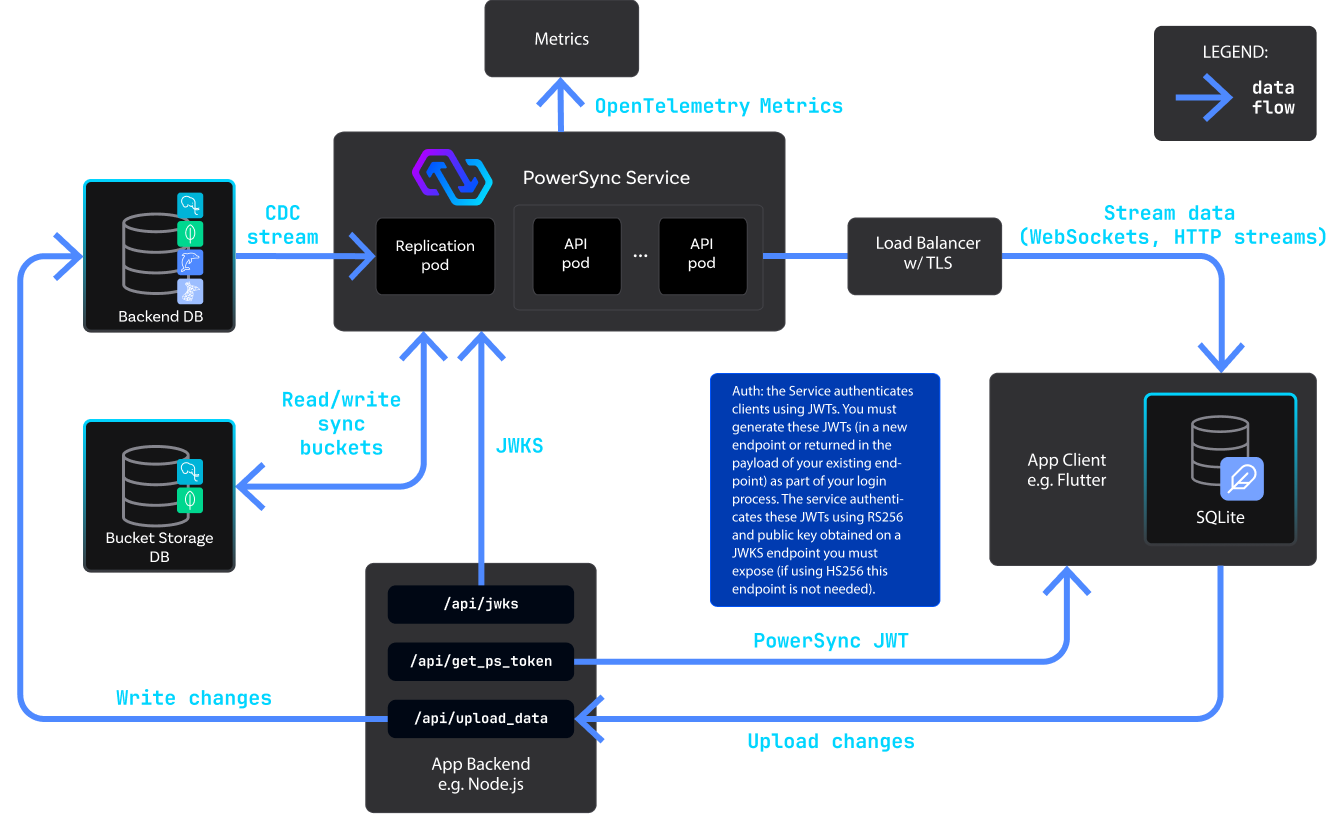 Data doesn't always flow in the direction of your firewall rules, so the below table documents which components are making connections to others:
| Request Originator | Request Destination | Protocol |
| ------------------ | -------------------------- | ----------- |
| PowerSync Service | Postgres | TCP |
| PowerSync Service | MongoDB | TCP |
| PowerSync Service | OpenTelemetry Collector | TCP or UDP |
| PowerSync Service | JWKS Endpoint | TCP (HTTPS) |
| App Client | PowerSync Service (via LB) | TCP (HTTPS) |
| App Client | App Backend | TCP (HTTPS) |
| App Backend | Postgres | TCP |
Data doesn't always flow in the direction of your firewall rules, so the below table documents which components are making connections to others:
| Request Originator | Request Destination | Protocol |
| ------------------ | -------------------------- | ----------- |
| PowerSync Service | Postgres | TCP |
| PowerSync Service | MongoDB | TCP |
| PowerSync Service | OpenTelemetry Collector | TCP or UDP |
| PowerSync Service | JWKS Endpoint | TCP (HTTPS) |
| App Client | PowerSync Service (via LB) | TCP (HTTPS) |
| App Client | App Backend | TCP (HTTPS) |
| App Backend | Postgres | TCP |